Park Slope Condo Market Recap: 2021-2026
Fewer Sales and Higher Prices: Five Years of the Park Slope Condo Market 2021-2026
What five years of sales reveal about rising interest rates, buyer demand, and a neighborhood that continues to command a premium.
Ask a prospective homebuyer what should happen to housing prices when mortgage rates climb, and the answer seems straightforward. Higher borrowing costs reduce purchasing power, fewer buyers compete for available homes, and sellers eventually have to adjust their prices. When the Federal Reserve began raising interest rates in March 2022, many buyers expected that scenario to play out in Park Slope. Some adjusted their budgets, while others put their searches on hold, hoping that a slower market would create an opportunity to purchase a home at a discount.
Five years of Park Slope condo sales tell a more complicated story. Transactions fell sharply from their post-pandemic peak, and the time it took properties to go into contract initially increased. Prices also experienced a modest correction in 2023, but the decline was short-lived. By 2025, sales activity was recovering, properties were going into contract more quickly, and prices per square foot had climbed beyond their previous highs.
The available 2026 sales data shows that trend continuing, with median prices per square foot reaching their highest level of the five-year period. Fewer transactions, higher prices, and a market that ultimately moved faster despite substantially higher borrowing costs. Understanding how Park Slope got here requires looking beyond the broader housing market and examining what actually happened in the neighborhood.
The Running Start
To understand what happened when interest rates began rising, it helps to remember just how active the market was immediately beforehand. The pandemic brought New York City's residential real estate market to a near standstill in the spring of 2020. Showings and open houses were suspended, transactions were delayed, and buyers and sellers faced an uncertain future. By the spring of 2021, however, the market had come roaring back.
Buyers who had postponed their searches returned, supported by historically low mortgage rates and, in many cases, a renewed appreciation for having more space at home. Park Slope, with its historic brownstone streets, proximity to Prospect Park, a school zone parents reorganize their entire lives around, and convenient access to Manhattan, was well positioned to benefit from that renewed demand. The neighborhood recorded an exceptionally active spring selling season, with 34 condo sales in March, 40 in April, and 47 in June.
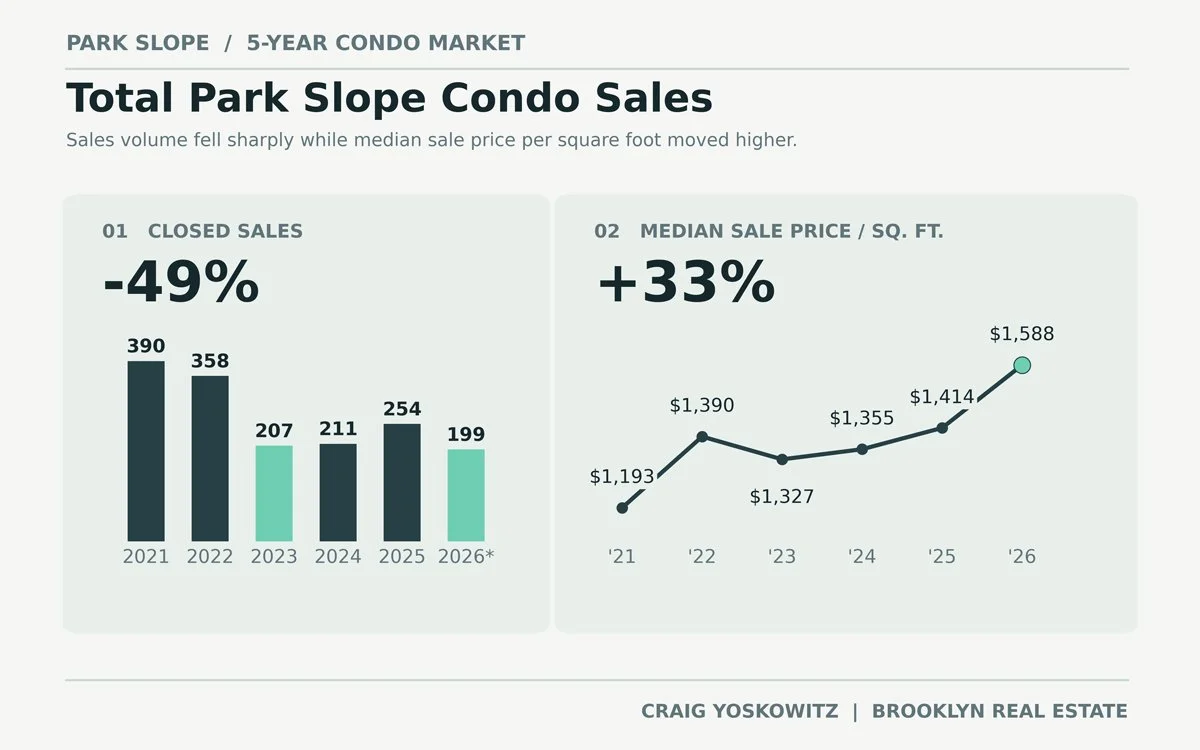
By the end of 2021, Park Slope had recorded its highest annual condo sales activity since 2010, with 390 distinct transactions in the sales data. Buyers who had spent much of the previous year waiting were back in the market, competing for the homes that became available. The five-year period that followed didn't begin with a struggling market searching for its footing. It began with one already running at a full sprint.
When the Cost of Money Changed
The post-pandemic surge didn't go untested for long. In March 2022, the Federal Reserve began an aggressive series of interest rate increases to combat inflation, setting in motion a period of substantially higher mortgage borrowing costs. For prospective homebuyers, the implications were significant. A higher mortgage rate meant a larger monthly payment on the same purchase price, reducing the amount many buyers could comfortably afford.
But rising rates affected homeowners, too. Someone who had purchased or refinanced a property with a mortgage rate near 3% faced a very different financial calculation when considering selling that home and purchasing another at a substantially higher rate. Unless a move was necessary, staying put was likely the more attractive financial decision. The same borrowing costs that discouraged some buyers also gave existing homeowners a compelling reason not to sell.
In Park Slope, transaction activity began to slow. Following 390 distinct condo sales in 2021, the neighborhood recorded 358 in 2022. By 2023, that number had fallen to 207, a decline of nearly 47% from the post-pandemic peak, the third-fewest full year for condo transactions since 2010, behind only the 2020 shutdown and a quiet stretch in 2016 that had nothing to do with either disruption. Activity remained relatively subdued in 2024 before recovering to 254 sales in 2025.
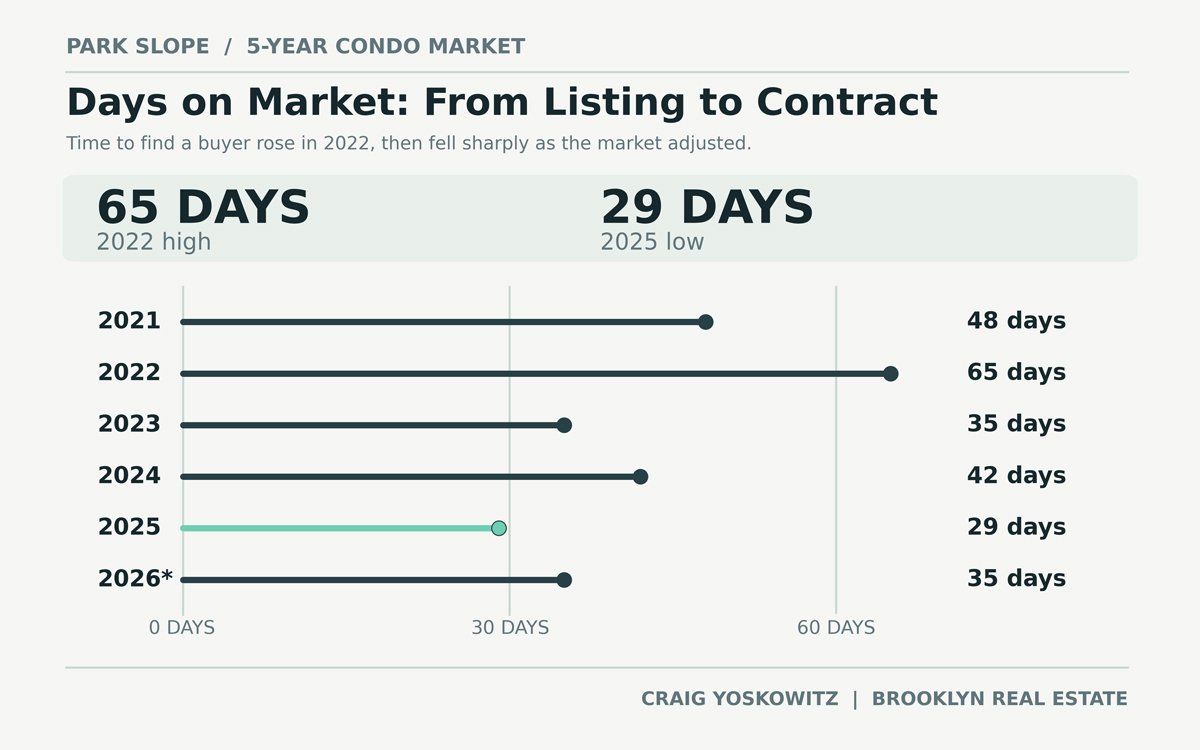
The initial slowdown also showed up in the time it took properties to find buyers. In 2021, the median time between listing and contract for closed condo sales was 48 days. That figure climbed to 65 days in 2022, as buyers adjusted to higher borrowing costs and a changing financial environment. For a period, the market appeared to be moving in the direction many had anticipated: fewer transactions and a longer wait for sellers.
But prices and marketing times would soon tell a different story.
Low Inventory Didn't Mean Lower Prices
In 2021, the median sale price per square foot for Park Slope condos was $1,193. That figure increased to $1,390 in 2022 before declining to $1,327 in 2023, a drop of 4.5 percent. The market had experienced a significant reduction in transaction volume and a modest correction in pricing. For buyers who had been waiting for higher interest rates to bring prices down, there was finally some evidence of a shift.
The correction, however, didn't last. By 2024, median price per square foot had recovered to $1,355. It increased again in 2025, reaching $1,414, and climbed to $1,588 during the first eight months of 2026. Compared with 2021, the median price per square foot among completed condo sales had increased by roughly one-third.
The more interesting finding is that pricing and transaction volume followed such different paths. Park Slope experienced a sharp decline in the number of condos changing hands, yet that slowdown produced only a relatively brief correction in median sale prices. Even as borrowing costs remained far higher than they had been in 2021, the prices buyers paid for the homes that sold continued to climb.
The time it took those homes to go into contract tells an equally interesting story. After reaching 65 days in 2022, median days on market fell to just 35 in 2023, even as transaction volume reached its lowest point of the five-year period. That figure increased modestly to 42 days in 2024 before declining to 29 days in 2025. During the first eight months of 2026, the median stood at 35 days, still considerably faster than during the initial rate-hiking period.
In other words, 2023 was one of the quietest years for Park Slope condo sales, but the properties that sold were going into contract in about half the time they had the previous year. By 2025, that period had shortened to less than a month. The market wasn't simply experiencing fewer transactions. It was experiencing fewer transactions alongside relatively short marketing times, while the pricing correction proved brief.
Limited inventory is an important part of the explanation. Fewer sellers meant fewer choices for buyers who were still looking, and a shorter supply of homes relative to demand can keep prices firm even as transaction volume falls. While the completed sales data doesn't measure inventory directly, the combination of fewer transactions, rising prices, and relatively short marketing times is consistent with a market where buyers continued to face meaningful competition for the homes that became available.
A Market That Held Up Across Apartment Sizes
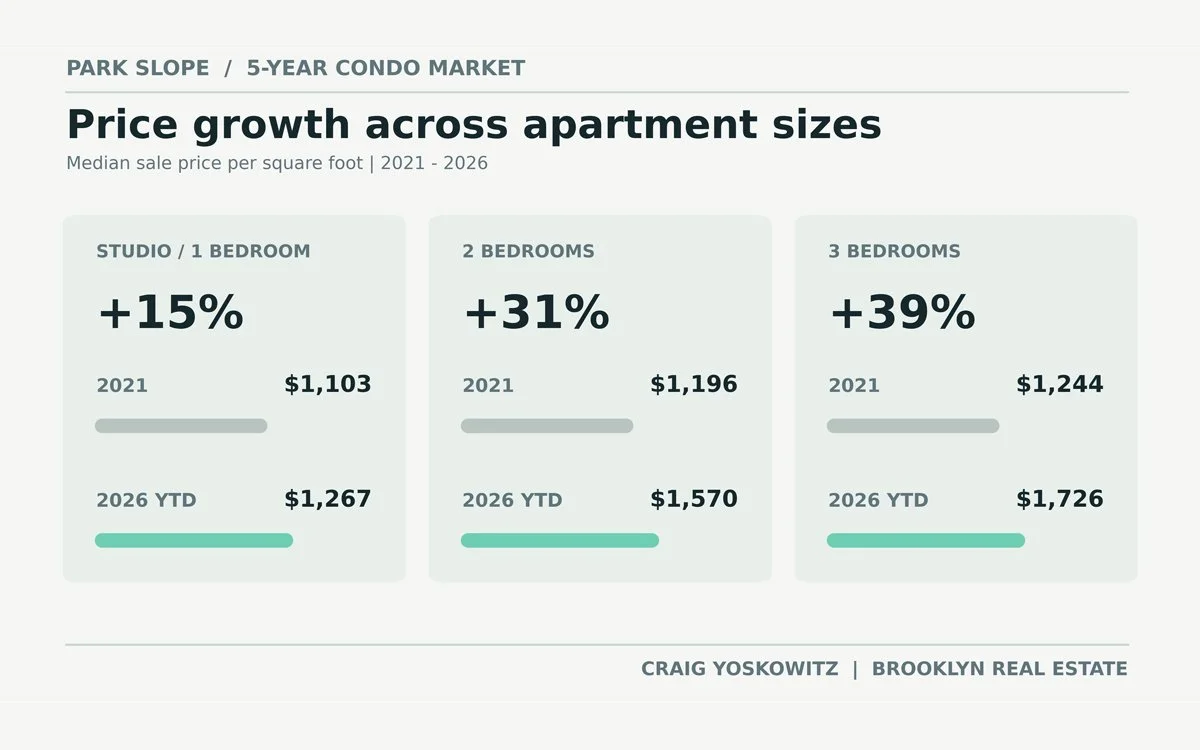
One possible explanation for rising neighborhood-wide prices is that the mix of sales simply shifted toward larger, more expensive apartments. The bedroom-count data does not support that. Two-bedroom and three-bedroom condos have consistently made up a large majority of Park Slope's annual transactions, and that mix barely moved: apartments with three bedrooms or more were about 40 percent of sales in 2021, and about 38 percent from 2023 through today, a slightly smaller share, not a larger one.
Prices rose within every bedroom category on its own. Two-bedroom condos went from $1,196 per square foot in 2021 to $1,570 in 2026, up about 31 percent. Three-bedroom condos went from $1,244 to $1,726, up about 39 percent. Even studios and one-bedrooms climbed, up about 15 percent, a smaller gain than the larger units but still real.
A three-bedroom condo sold in 2026 isn't necessarily identical to one sold in 2021. Location, condition, building amenities, and outdoor space all influence value. But the consistency across apartment sizes is the point. Park Slope's price growth wasn't simply the product of a shifting sales mix. Higher median prices per square foot were evident within each bedroom category.
What Waiting Actually Costs
For buyers who put their search on hold in 2022, hoping that higher rates would eventually bring Park Slope prices down, the last several years have been a difficult trade-off. There was a correction in 2023, but it was modest and short-lived. By 2024 prices were rising again, and by 2025 they had surpassed their previous high. The same type of apartment now generally commands a higher price per square foot than it did when the wait began, and the broad market correction some buyers anticipated never materialized.
That does not mean buying sooner would have been right for everyone. Someone planning to stay in a property for ten years is making a different calculation than someone whose needs may change in a few years, and carrying costs matter as much as the purchase price. What the last five years actually demonstrate is the risk in assuming higher rates automatically mean lower prices. Predicting exactly when rates or prices bottom out is difficult. Understanding what an individual property is worth in today's market is a far more practical place to start.
Why Pricing Still Decides Everything
For sellers, the lesson runs in the other direction. The years with the fewest recorded sales were not years when Park Slope buyers disappeared. Buyers were still there, but the importance of understanding how an individual property fits into the market never went away. A condo priced appropriately for its block, its building, and the competition available when it enters the market can attract meaningful interest, even when overall transaction volume is down. A property priced primarily around an owner's expectations, rather than what comparable homes are actually selling for, faces a more difficult path to finding the right buyer.
A neighborhood doesn't sustain demand through a period like this by accident. Park Slope's residential streets, neighborhood schools, proximity to Prospect Park, and limited supply of certain types of homes have continued to attract buyers, even as the cost of financing a purchase increased substantially. Construction along Fourth and Fifth Avenues has introduced additional inventory, but it hasn't eliminated the competition for the homes buyers want most. Higher interest rates changed the market, but they didn't change the fundamental reasons people want to live in Park Slope.
Work With Craig
Whether you're buying, selling, or simply trying to understand where you fit in the Park Slope market, thoughtful advice starts with the specifics. Let’s talk about your property, your search, and what the current market means for you.