
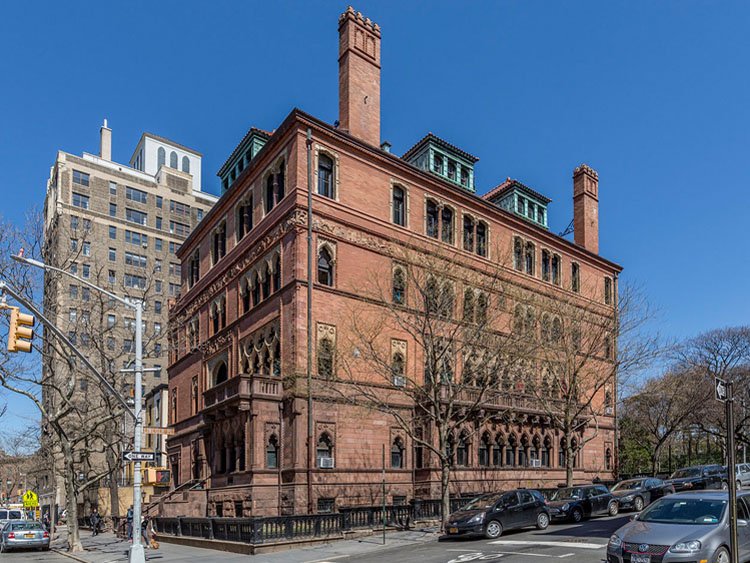
The Montauk Club, Park Slope
What the Buildings Tell You About the Borough
Brooklyn has more intact 19th and early 20th century residential architecture than almost any place in America. That's not an accident. The borough's development happened fast, then largely stopped, which means block after block of well-built townhouses survived while other cities tore theirs down. The result is a built environment that people genuinely want to live in, which is one of the less complicated explanations for why Brooklyn real estate commands the prices it does.
Here is a look at four neighborhoods where the architecture is particularly worth understanding.
Park Slope
Park Slope's brownstones are what most people picture when they think of Brooklyn. The neighborhood developed rapidly in the second half of the 19th century as wealthy Manhattan residents discovered the height of the Slope and the views it offered over the harbor. Developers built quickly and built well, and the result is one of the most consistently intact Victorian streetscapes in the country.
The material that gives the neighborhood its name is a warm-toned Triassic sandstone quarried mainly in New Jersey and Connecticut. It weathers beautifully and photographs even better, which accounts for a disproportionate share of Brooklyn's Instagram presence. The dominant architectural styles are Italianate, Neo-Grec, and Romanesque Revival, with high stoops, decorative ironwork, deep cornices, and interiors that tend toward high ceilings and generous proportions.
Two buildings worth knowing: the Montauk Club at 25 Eighth Avenue, completed in 1891 and designed by Francis H. Kimball in Venetian Gothic style with terracotta reliefs drawn from Montauk Native American motifs, is one of the most unusual and beautiful buildings in Brooklyn. It was partially converted to residential condominiums in 1996. The Brooklyn Conservatory of Music at 58 Seventh Avenue, built in 1881 in Victorian High Gothic style, has had several lives since its construction, but has been the Conservatory since 1944 and remains one of the neighborhood's more important cultural institutions.

Sterling Place, Prospect Heights
Prospect Heights
Prospect Heights developed slightly later than Park Slope and shows it in the architectural range. The neighborhood's townhouses include brownstones, brick row houses, and limestone structures, with styles spanning Greek Revival, Italianate, Neo-Grec, and Romanesque Revival, sometimes within the same block. The effect is less uniform than Park Slope and arguably more interesting for it.
The neighborhood's character is defined as much by its proximity to its major institutions as by the buildings themselves. The Brooklyn Museum, the Botanic Garden, and Prospect Park all border Prospect Heights directly, which gives it a cultural density that's unusual for a residential neighborhood of its size. The blocks closest to Grand Army Plaza carry a particular elegance, with wider lots and buildings that were clearly built for people who had money and wanted everyone to know it.

St. Marks Ave, Crown Heights
Crown Heights
If Park Slope is defined by brownstone and Prospect Heights by variety, Crown Heights is defined by limestone. The grand townhouses along Eastern Parkway and the blocks surrounding it were built primarily in the early 20th century and favor Renaissance Revival and Beaux-Arts styles, with carved stonework, bay windows, and a scale that can feel genuinely palatial.
The Parkway itself was designed by Frederick Law Olmsted and Calvert Vaux, the same team responsible for Prospect Park and Central Park, and the buildings that line it were built to match the ambition of the street. Crown Heights remained undervalued for a long time relative to the quality of its housing stock, which is why it has seen some of the most dramatic price appreciation in Brooklyn over the past fifteen years. The buildings were always there. The market eventually caught up.

Arlington Place, Bedford-Stuyvesant
Bedford-Stuyvesant
Bed-Stuy has the largest concentration of intact Victorian brownstones in the United States. The neighborhood developed in the late 19th and early 20th centuries, and its townhouses reflect the full range of styles that characterized that period: Italianate, Queen Anne, Romanesque Revival, with grand stoops, ornate cornices, and woodwork that would be difficult and expensive to replicate today.
Two landmarks worth knowing. On Stuyvesant Avenue between Lexington and Quincy, the block where Spike Lee filmed most of Do the Right Thing in 1989 looks almost entirely unchanged. Mookie's brownstone at 173 Stuyvesant Avenue is still there. If you haven't seen the film, stop reading this and go watch it first.
At 526 MacDonough Street is the former home of Jackie Robinson and his wife Rachel. Robinson broke the color barrier in Major League Baseball when he joined the Brooklyn Dodgers in 1947. The brownstone's distinctive stoop was used in the 2013 film 42 because the filmmakers wanted a building that captured the period accurately. It does.
Buying or Selling a Brooklyn Townhouse?
Brownstones and townhouses are among the most sought-after properties in the borough, and also among the most nuanced to price and sell. If you're thinking about buying or selling one, I'm happy to talk through what the process looks like.
